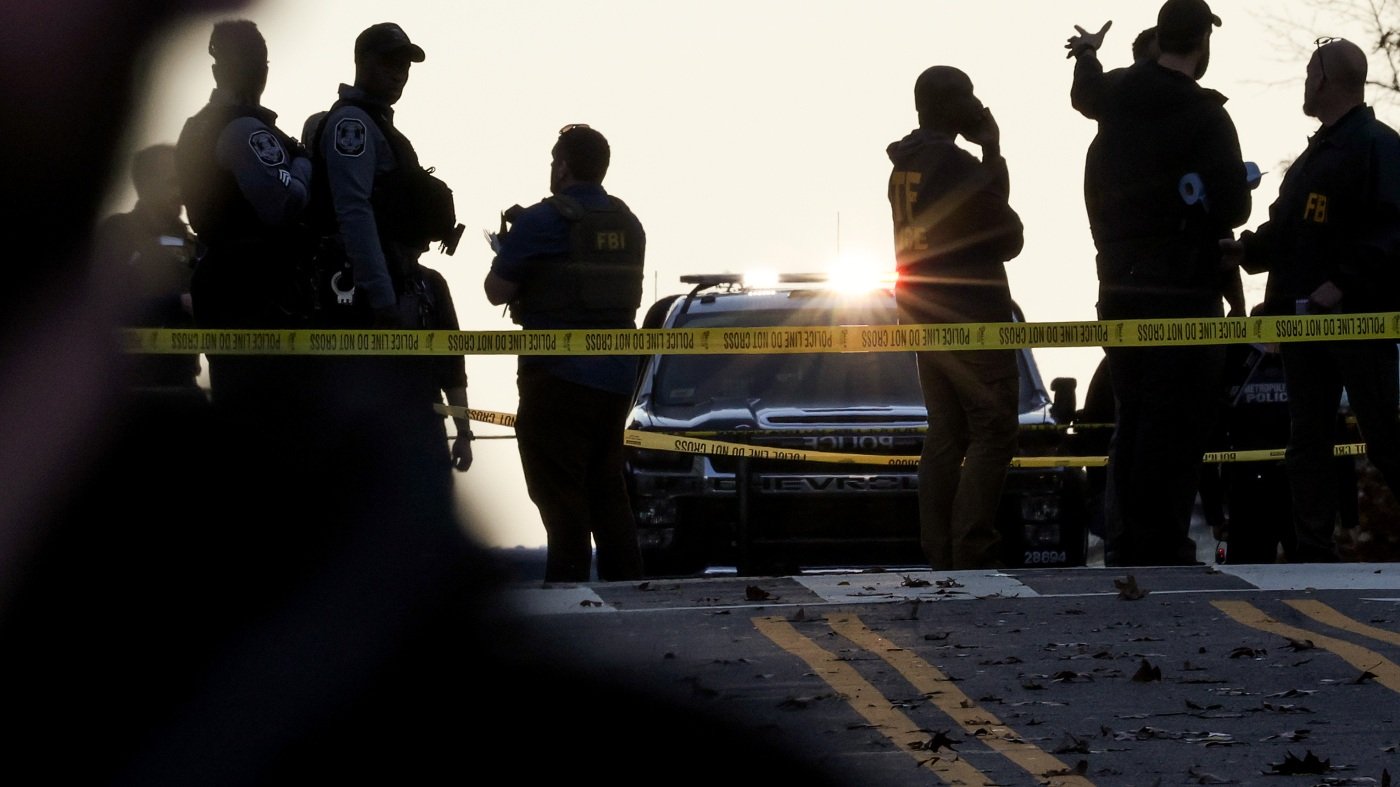

Members of law enforcement, including the U.S. Secret Service and the Washington Metropolitan Police Department, respond to a shooting near the White House on November 26, 2025 in Washington, DC. Two members of the West Virginia National Guard were shot not far from the White House.
Vin McNamee/Getty Images North America
hide caption
toggle caption
Vin McNamee/Getty Images North America
According to a volunteer who worked closely with his family, Rahmanullah Lakanwal appeared vibrant and full of hope when he came to America from Afghanistan, but over the years, he became isolated and began driving cross country without telling his family.
Afghan citizen Lakanwal is accused of shooting two National Guard soldiers on November 26. One of those soldiers, 20-year-old Sarah Beckstrom, died of her wounds. On Monday, West Virginia Governor Patrick Morrisey described the second Guardsman, 24-year-old Andrew Wolfe, in “critical” condition.
“My biggest concern was that (Lakanwal) would harm himself,” the refugee resettlement volunteer told NPR. “I was worried he would commit suicide because he was so withdrawn.”
The volunteer spoke to NPR on condition of anonymity because he said he feared for his safety, and the safety of others in his volunteer community, for potential retribution for working with Afghan refugees, including Lakanwal.
He said that when he first met Lakanwal in 2022 at his home in Bellingham, Washington, he seemed hopeful and friendly. “He was outside laughing, playing with his children and having animated conversations with other Afghan men,” he said.
Lakanwal held jobs for a while and hosted functions at his home, but by 2023 he began isolating himself and appeared “defeated” by the challenges of finding steady work and adapting to life in the US, the volunteer said.
The volunteer shared emails with NPR sent in January 2024, raising concerns about Lakanwal’s well-being.
“He spends most of his time in his dark bedroom, not talking to anyone, not even his wife and older children,” it said in an email. “I personally believe that (Mr. Lakanwal) is suffering from both PTSD and his work with the US military in Afghanistan,” the volunteer wrote. He also said he was “not a health care professional.”
speaking on nbc meet the Press On Sunday, Homeland Security Secretary Kristi Noem said US officials believed Lakanwal had become “radicalized” while living in the US.
“We believe it was through connections in his home community and state and we will continue to talk to people who interacted with him,” Noem said.
But a volunteer who worked with Lakanwal and other Afghan refugees in Washington state told NPR they saw no sign of radicalization. Instead he described a man who was experiencing a deep personal crisis, compounded by Lakanwal’s poor English-language skills and deep cultural alienation. The volunteer said there were no organized resources for refugees beyond their initial welcome.
“I think the families were released into the community,” the volunteer said.

This photo provided by the U.S. Attorney’s Office on Thursday, Nov. 27, 2025, shows Rahmanullah Lakanwal.
AP/US Attorney’s Office
hide caption
toggle caption
AP/US Attorney’s Office
Before coming to the US in 2021, Lakanwal served in one of Afghanistan’s elite counterterrorism units, according to AfghanEvac, a nonprofit that supports Afghan refugees run by American veterans and others who served in Afghanistan. According to AfghanIQ, Lakanwal’s unit was operated by the CIA with direct US intelligence and military support, and fought the Taliban on behalf of the US government.
CIA Director John Ratcliffe said in a statement last week that the shooter involved in the attack had been recruited to the US “due to his prior work with the US government, including the CIA.”
The volunteer told NPR that he had no detailed knowledge of Lakanwal’s military duties and that he never saw him express hostility toward the United States. He said his increasingly erratic behavior never indicated any kind of threat or danger.
The volunteer said, “I was very surprised that this happened. I asked myself, were there warning signs? No.”
Although the volunteers could not provide information about Lakanwal’s possible motive for the alleged attack, they did know that he had been making long drives like the one to Washington, D.C., the previous week. In early 2023, Lacanval will disappear for a week in the family car, driving through Arizona and Illinois.
“He drives around day and night and sends map pins to one of the volunteer sponsors and we can take photos from Instagram stories, but no other communication. His family generally has no idea where he is or when he will return,” said one of the volunteer group’s emails, written in January 2024.
Emails shared with NPR also indicate that volunteers in Washington state attempted to reach out to professional refugee aid groups, including World Relief and the U.S. Committee for Refugees and Immigrants (USCRI), in hopes of getting help for Lakanwal’s worsening mental state, but received limited response.
“A group of concerned individuals (volunteering on refugee resettlement) in the Seattle area had a meeting in January 2024 to talk about dwindling resources for these families, and frustrations were expressed,” the volunteer told NPR.
NPR contacted World Relief and USCRI for comment. USCRI did not respond. World Relief sent a statement declining to say whether the organization had any involvement in Lakanwal’s resettlement in the U.S.
“We cannot confirm whether we served a specific client without the permission of our federal government partners, who managed the process of bringing Afghans to the United States beginning in 2021,” the World Relief statement said.
The group said it “provided services to (refugees) that were assigned for use by our government partners” and said it was supporting law enforcement in their investigation of Lakanwal’s case.
Following last week’s violence, the Trump administration halted refugee cases involving Afghan citizens and began reviewing refugees and immigrants from more than a dozen countries who are legally living inside the United States. Activists who work with Afghan asylum seekers told NPR that they view Lakanwal’s alleged violence as an isolated case.
“You can’t paint this entire community with a broad brush. Most of the Afghans who come here are just good upstanding citizens,” said Shawn VanDiver, a Navy veteran who heads the AfghanEvac group.
<a href