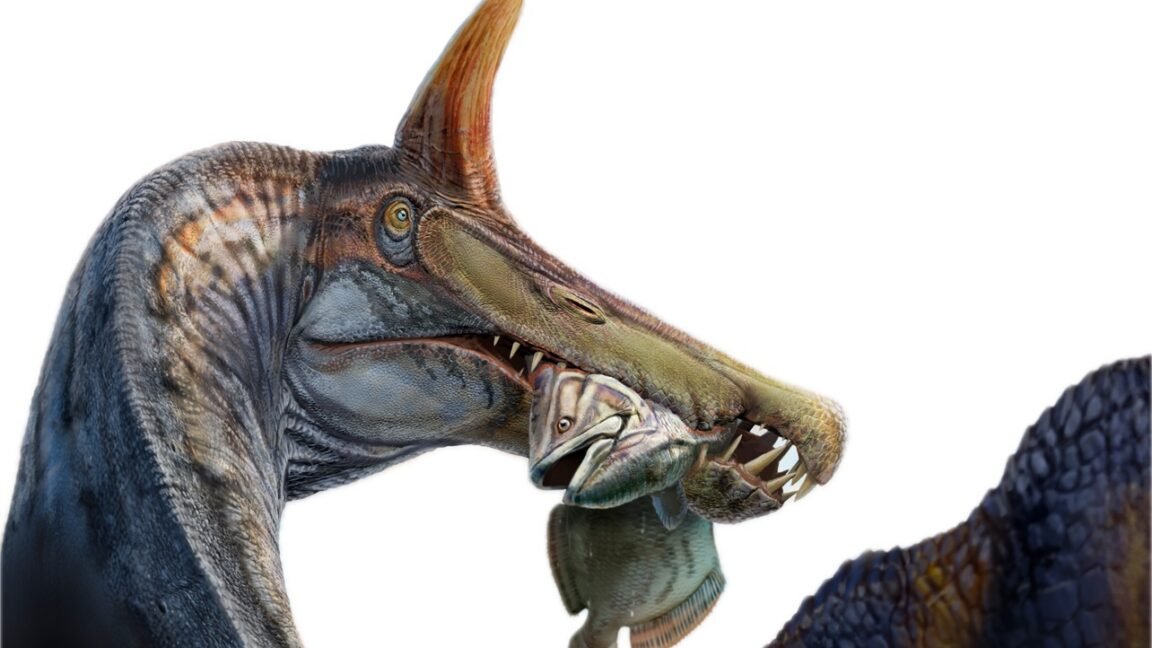
but there was one thing that made s mirabilis different from S. aegyptiacus. The word “mirabilis” in the name of the newly discovered Spinosaurus translates to “wonderful” in Latin. What Sereno’s team found most surprising was the prominent crest on top of the animal’s head, one of the largest we have ever discovered.
scissor crown
Fluted ridges appear in place of rugged terrain S. aegyptiacus, s mirabilis It had a blade-shaped, scimitar-like bony crest that curved upward and backward from its snout, reaching above its eyes. This structure was made of solid bone, unlike the highly porous, pneumatic covering found on some modern birds. However, the bone was carved with fine longitudinal striations and deep grooves, indicating that the core of the bone was just the base.
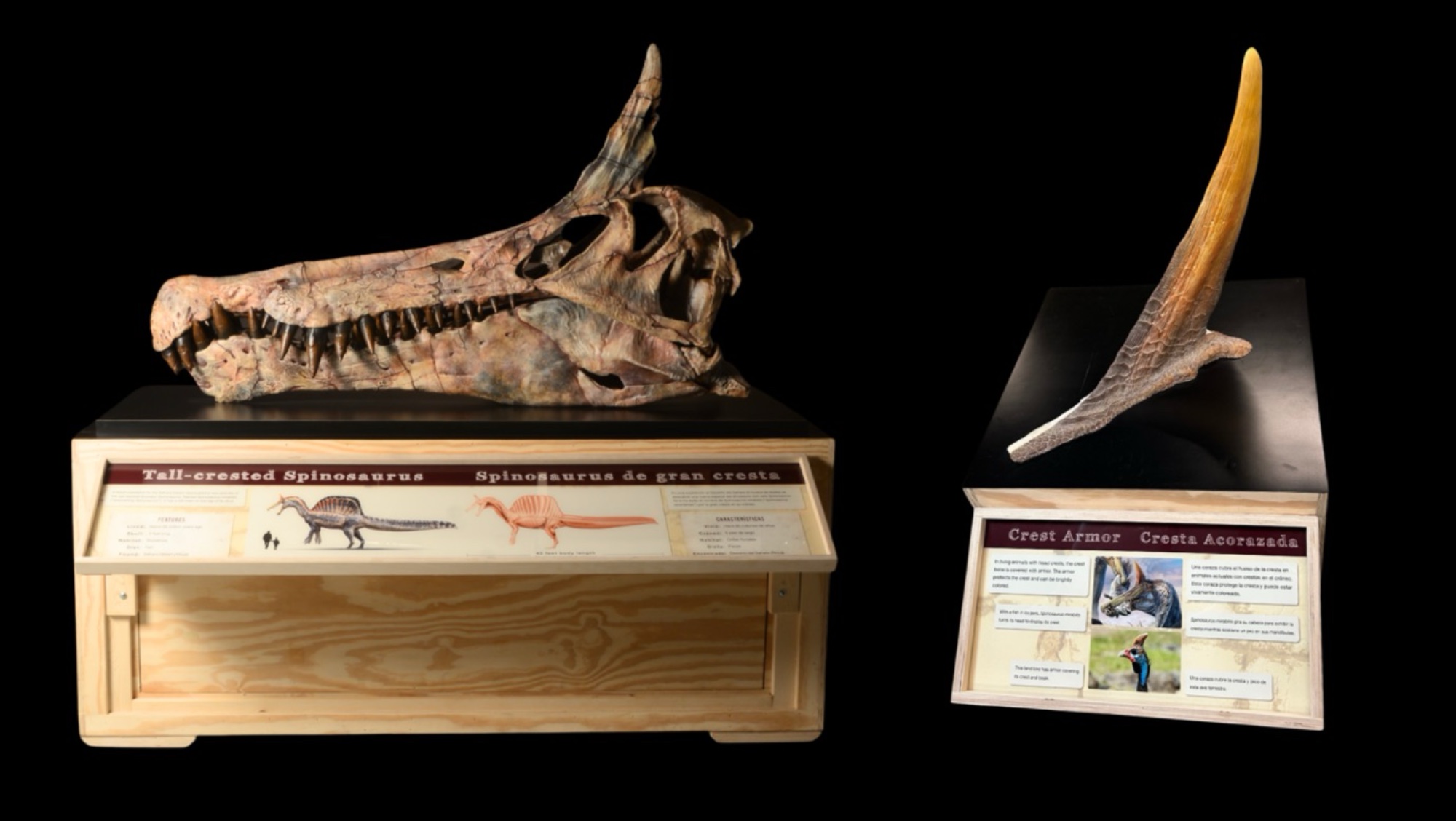
Newly discovered skull, along with a model of what its spikes might have looked like on a living animal.
Newly discovered skull, along with a model of what its spikes might have looked like on a living animal.
Credit: UChicago Fossil Lab
in livelihood s mirabilisThis crest would have been covered by a keratinous covering and greatly expanded, like the live growths developed by modern helmeted guinea fowls. If this were scaled up to a fully mature adult, the length of the bone core alone would be approximately 40 centimeters; With its keratinous covering, it could easily have been over half a meter long. To Sereno, the purpose of this “stunning” scimitar crown was similar to the crests worn by cranes and herons today. “It was asymmetric. It varied between individuals. So, I think it was just for display,” Sereno explains.
His team speculates that visual signaling was the primary function of both the cranial crests and the huge trunk and tail sails that define spinosaurids. In crowded shoreline and riverine habitats, a high, brightly colored crest or sail would be a great way to broadcast your size, maturity, and genetic fitness to rivals and potential mates, without getting involved in costly physical fights.
Still, when it came down to it, s mirabilis, Weighing more than 7 tons, can totally brawl. “Spinosaurus was huge. I think it could eat whatever it wanted, even though its main diet was fish,” Sereno says.
crocodile jaw
The showpiece on her forehead aside, s mirabilis Was a highly specialized killing machine. Its snout appears to have a low profile with parallel dorsal and ventral margins, ending in a mushroom-shaped extension at the tip. The upper and lower jaws allowed the teeth to fuse completely together – there was a notable diastema, a gap in the upper row of teeth, which neatly accommodated the larger teeth of the lower jaw. s mirabilis The jaw structure appears similar to that of modern long-snouted crocodiles, adapted for snatching and trapping aquatic prey with rapid, trap-like closure. It’s surprising, s mirabilis A greater distance between the teeth was observed in the rear half of its snout compared to S. aegyptiacus Despite being otherwise almost identical.
<a href