Flying drones used during the Ukraine war have forever changed land warfare tactics. Now the same thing seems to be happening under the sea also.
Navies around the world are racing to add autonomous submarines. Britain’s Royal Navy is planning a fleet of Underwater Uncrewed Vehicles (UUVs), which for the first time will play a leading role in tracking submarines and protecting undersea cables and pipelines. Australia has committed to spending $1.7 billion (£1.3 billion) on “Ghost Shark” submarines to counter Chinese submarines. The giant US Navy is spending billions on several UUV projects, including one already in use that can be launched from nuclear submarines.
Scott Jamieson, managing director of maritime and land defense solutions at BAE Systems, Britain’s leading arms company and maker of its nuclear submarines, said autonomous unmanned submarines represent “a real step-change in the undersea warfare arena.” New drones under development will allow navies to move forward in ways not previously available “at a fraction of the cost of manned submarines,” he said.
A huge new market opportunity is pitting big, experienced defense companies including BAE Systems and America’s General Dynamics and Boeing against weapons technology startups like US firm Anduril – maker of the Ghost Shark – and Germany’s Hellsing. Startups claim they can move faster and cheaper.
The struggle for undersea dominance has been almost continuous in peacetime and war for most of the last century.
The first nuclear-powered submarine (America’s Nautilus, named after Jules Verne’s fictional ship) was launched in 1954, and nuclear-armed ships are now the centerpiece of the armed forces of six countries – the US, Russia, Britain, France, China and India – while North Korea recently became the seventh. This is despite deep controversy over whether the weapons represent value for large sums of money, and whether such a destructive arsenal actually serves as a useful deterrent.
Those armed forces are constantly playing a game of hide and seek on the oceans. To avoid detection, submarines rarely surface: maintenance problems on other ships recently forced some British submarines to spend a record nine months underwater carrying Trident nuclear missiles that are theoretically ready to strike at any time.
Tracking Russia’s underwater nuclear arsenal – which has quieted down in recent years – is the Royal Navy’s main focus, particularly focusing on the Greenland-Iceland-UK (GIUK) gap, a “chokepoint” that allows NATO allies to monitor Russian movements in the North Atlantic. The South China Sea is another promising market, an arms executive said, as China and its neighbors face off in a tense, long-running territorial dispute.
Underwater drones promise to make it easier to track rivals’ submarines. According to an executive hoping to sell in the UK, some of the sensors are designed to remain hidden on the ocean floor for months at a time, detected by other UUVs.
The second motivation is the increasing number of apparent attacks on oil and gas pipelines, such as the Nord Stream attack in 2022, for which Germany has identified a Ukrainian suspect, and the damage to the BalticConnector pipeline between Finland and Estonia in 2023. Undersea power and internet cables are also vital to the global economy. An underwater power cable between Finland and Estonia was affected last Christmas, two months after two telecommunications cables were cut in Swedish waters in the Baltic Sea.
The British government last week accused Russia’s Yantar surveillance ship of entering British waters to map undersea cables. It says Britain has seen a 30% increase in the number of Russian vessels threatening British waters over the past two years.
Parliament’s Defense Select Committee has raised concerns over Britain’s vulnerability to undersea sabotage, known as “grey zone” actions, which could cause major disruption but are less likely than acts of war. Damage to 60 undersea data and energy cables around the British Isles “could have devastating consequences for the UK”, the committee said.
Andy Thomas, chief executive of Cohort, a British manufacturer of military technology including sonar sensors, said the crewed ships, aircraft and submarines used so far to track nuclear-armed submarines or sabotage ships were “very, very capable and very, very expensive”. But, he said, “in combination with uncrewed ships, you get the ability to make decisions that humans can without putting you in very dangerous proximity”.
The cohort hopes that some of its towed sensors (named Krait after the sea snake) could be used on small autonomous ships.
The latest ships have five times more sonar sensors than submarines currently in service. Low power requirements are particularly important for small, uncrewed ships that do not have nuclear reactor facilities on board. Passive sensors – those that do not send sonar “pings” – become harder to detect and destroy.
The Royal Navy, and the armed forces in general, are not known for quickly implementing the latest technology. However, Ukraine’s forces have learned that speed and low cost are key when it comes to building drones for the air and sea. For undersea drones, the Defense Ministry is trying to learn that lesson, calling for rapid development of technical demonstrators under “Project Cabot.”
After newsletter promotion
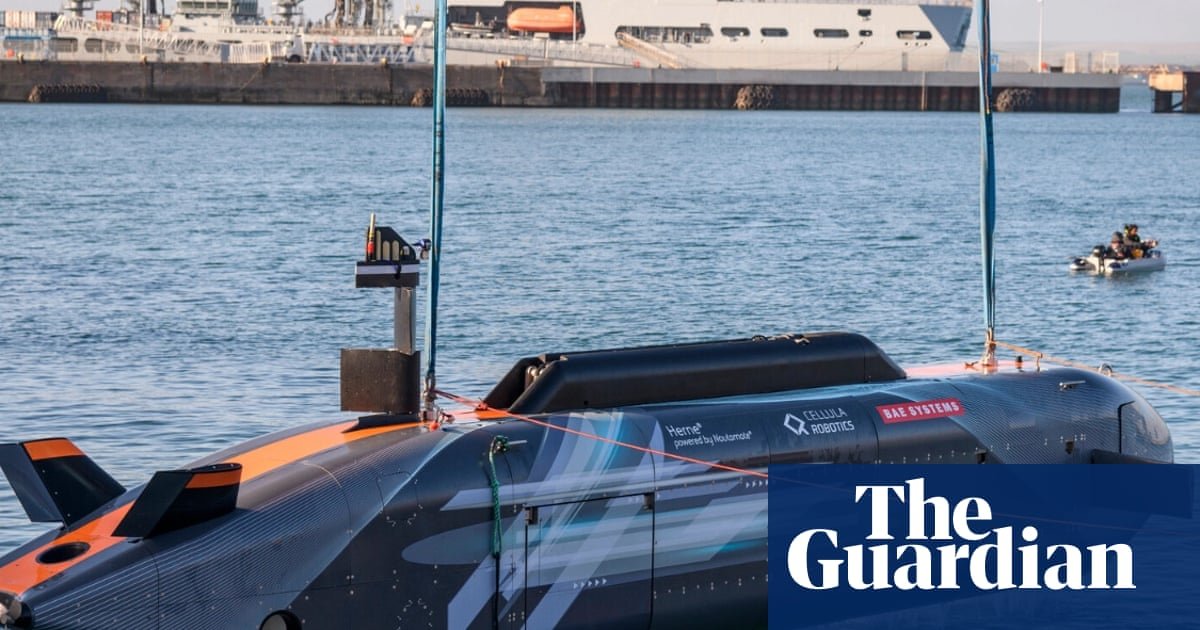
BAE has already tested a potential contender, called Hearn. Helsing is building a facility in Portsmouth, home of the Royal Navy, to make underwater drones. Anduril, which is run by Donald Trump fundraiser Palmer Luckey, is eyeing UK manufacturing sites.
Initial contract awards are expected this year, followed by trials in north-west Scotland by defense company QinetiQ, and a full-scale order to one or two companies, called Atlantic Net, to fill the GIUK gap with sensors.
According to a £24 million tender notice published in May, the Royal Navy describes the project as “anti-submarine warfare as a service”, based on the more common “software as a service”.
Siddharth Kaushal, a senior research fellow on sea power at the Royal United Services Institute think tank, said the submarine-hunting strategy of recent decades “does not escalate into conflict” because it requires an expensive mix of large “exquisite assets”.
Warships stretch cables more than 100 meters long that contain arrays of sonar sensors to try to pick up the weakest and lowest-frequency sounds. Aircraft such as Britain’s Boeing P-8 fleet drop disposable sonobuoys to detect submarines in the ocean depths, satellites scour the surface for wake signals left by submarine communications masts, and a scattering of hunter-killer submarines patrol beneath the waves.
The idea of cheap drones taking over a large portion of this work is attractive. Yet Kaushal warned that price gains “still remain to be seen”. Industry figures warn that a large fleet of UUVs will still come with significant maintenance costs.
Even for the protection of undersea cables, this could be a double-edged sword: sabotage would be both cheap and easy. The possibility of underwater drones firing at each other is “absolutely realistic,” one executive said.
The Ministry of Defense described it as “contractor-owned, contractor-operated, naval surveillance” – meaning that privately owned ships would be charged with anti-submarine warfare for the first time, potentially making them military targets.
“The first thing the Russians will do is go out and test it, and move it forward,” said Ian McFarlane, sales director of underwater systems at Thales UK. which already supplies the Royal Navy with sonar arrays towed by submarine-hunting ships, uncrewed surface boats and flying drones and hopes to play a role in Cabot by integrating that data.
However, McFarlane said, the attraction of bringing the companies on board was that the Royal Navy and its allies were looking for “now scale and persistence” to counter “an offensive that is growing rapidly”.
<a href