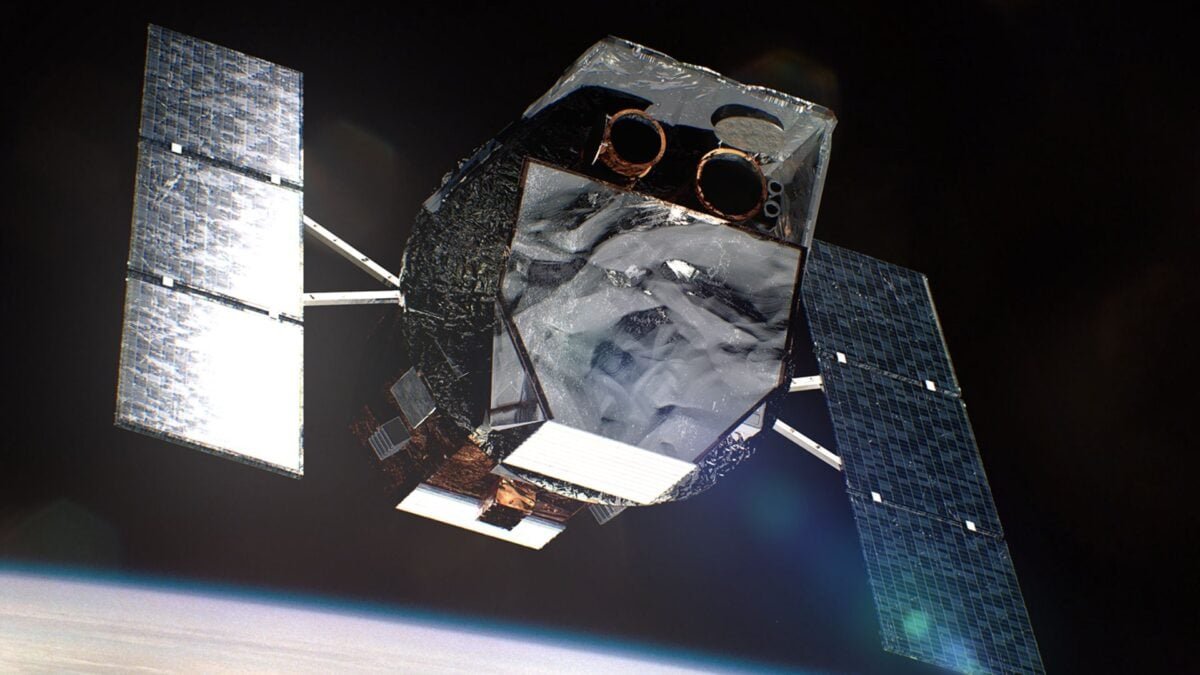

A NASA telescope orbiting Earth is slowly falling from the sky, with a 90% chance of uncontrolled re-entry by the end of 2026. To avoid this risk and extend the lifespan of the observatory, NASA has tapped an Arizona-based space flight startup to launch a daring rescue mission.
Catalyst Space Technologies, headquartered in Flagstaff, has been awarded $30 million from NASA to provide an orbital boost to the Neil Gehrels Swift Observatory. To that end, Catalyst is developing the “Link” spacecraft, designed to autonomously rendezvous with Swift and transfer it to a more stable orbit.
With a launch deadline of June 2026, Catalyst has less than eight months to get LINK off the ground and save Swift. Oh, and according to a company announcement made Wednesday, it plans to launch the mission via a rocket dropped from an aircraft. No big deal.
Saving the Swift from its slow end
The Swift Observatory was launched in 2004 to observe gamma-ray bursts – the most violent explosions in the known universe. In its two decades in low Earth orbit, Swift has slowly lost altitude, as all satellites do. But recent increases in solar activity have increased the atmospheric drag on the spacecraft, accelerating its orbital decay to an alarming rate.
As Swift sinks back to Earth, atmospheric drag intensifies. According to Catalyst, at this rate, the observatory has a 50% chance of uncontrolled reentry by mid-2026 and a 90% chance by the end of next year. Although Swift will burn up completely in the atmosphere and pose no threat to people or property on Earth, NASA and Catalyst hope to extend its lifetime.
Heroic Return of Pegasus
Catalyst has chosen Northrop Grumman’s Pegasus rocket as the launch vehicle for this rescue mission. Pegasus is an air-launched rocket, meaning it is dropped from a carrier aircraft at 40,000 feet (12,000 m), then free-floated for five seconds before igniting its first stage rocket motor and climbing into orbit.
Pegasus launch speeds have slowed significantly as cheaper, ground-launched rockets have become widely available. The Catalyst mission will be its first flight after 2021. According to the company, “Pegasus is the only system that can meet orbit, timeline and budget simultaneously.”
Swift orbits the planet at an inclination of 20.6 degrees to avoid the South Atlantic Anomaly – a large weak spot in Earth’s magnetic field that exposes satellites to high levels of radiation. Because of this, rockets launched from Cape Canaveral or Vandenberg would need enormous amounts of propellant to reach the right orbital plane for this mission, Kieran Wilson, vice president of technology at Catalyst, told SpaceNews.
The air-launch design of the Pegasus overcomes this limitation. And since it is a flight-proven vehicle, it is ready to launch at short notice.
According to Catalyst, once the Pegasus link is deployed, the spacecraft will approach Swift with a series of precise maneuvers, known as rendezvous proximity operations. Because Swift does not have a docking port or grappling fixture to hold the link, it will use a custom-built robotic capture mechanism to attach to a feature on the satellite’s body and adjust its orbit.
If the mission is successful, it will not only extend the lifespan of a highly valuable research satellite; This would represent a useful new capability for NASA. Being able to execute a rapid response to orbital decay will be a key asset for the agency, helping it better maintain its fleet of spacecraft in low-Earth orbit.
Пинко Казино предлагает широкий выбор онлайн-игр и азартных развлечений.
[url=https://7v4.casino/]Casino Pinco[/url]
Платформа постоянно развивается и совершенствуется.