spherical geometry
In spherical geometry, the sum of the interior angles of a triangle is greater than π. And in fact you can determine the area of a spherical triangle by how much the sum of the angles exceeds π. On a sphere of radius 1, the area is equal to triangle extra
Area= E = sum of interior angles − π.
The sum of the interior angles of small triangles is close to π. But, for example, you might have a triangle with three right angles: one vertex at the North Pole and two vertices spaced 90° apart at the equator.
hyperbolic geometry
In hyperbolic geometry, the sum of the interior angles of a triangle is always less than π. In a space with curvature -1, the area is equal to triangle defectThe difference between π and angle sum.
Area= D = π – sum of interior angles.
Again the sum of the interior angles of small triangles is close to π. Both spherical and hyperbolic geometry are locally Euclidean.
The interior angle sum can be any value less than π, and so as the angle sum goes to 0, the triangle defect, and hence the area, goes to π.
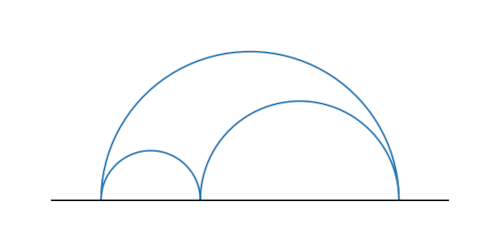
In the hyperbolic geometry shown below, the interior angle sum is 0 and the area is π.
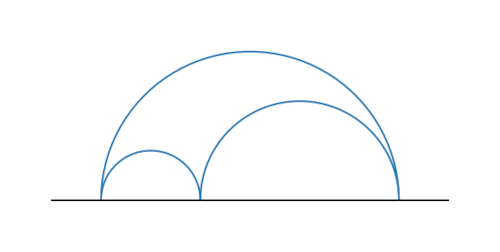
Strictly speaking, it is an improper triangle because the three hyperbolic lines (i.e. half circles) intersect at ideal points not within the hyperbolic plane but on the real axis. But you can get as close to this triangle as you want while staying within the hyperbolic plane.
Note that the radius of the (Euclidean) semicircle does not change the area. Any three semicircles that intersect on the real line as described above form a triangle of equal area.
Also note that the perimeter of a triangle is infinite but the area is finite.
<a href