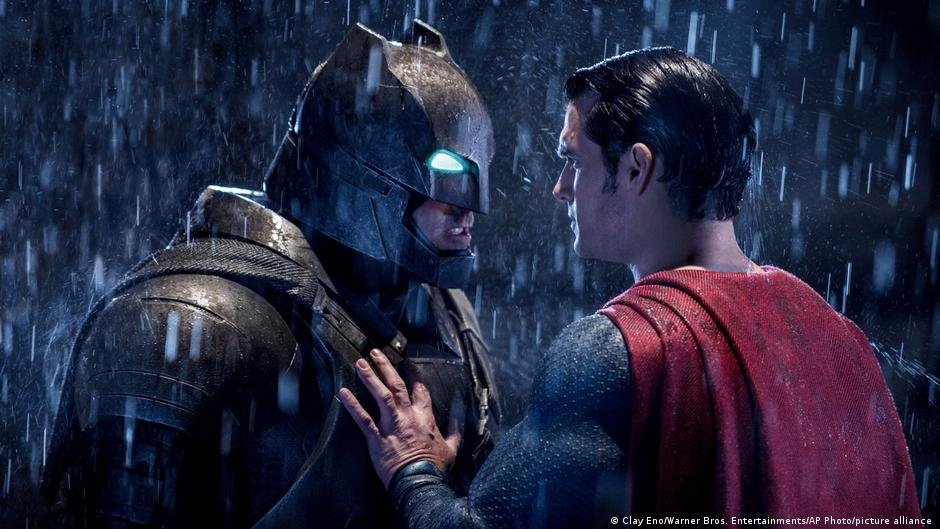
They can fly, are super-strong, or have some other cool moves. There are all kinds of different explanations of his special abilities.
For his part, Superman comes from the planet Krypton, which means he is actually an extraterrestrial being who resembles a human. A spaceship brought him to Earth as an infant, and he draws his superhuman powers from the Sun, which charges him, as well as from the low gravity of his home planet.
Meanwhile, Spider-Man is bitten by a radioactive spider, giving him “Spider Sense” and the ability to climb walls.
Sometimes genetics help too – like Wonder Woman, the daughter of an Amazonian and a god.
superheroes have always been around
“All the characters we see in comics and movies nowadays actually originated in ancient times or even earlier,” says archaeologist Michael Merkel, curator of the exhibition “Mythos Superhelden” at the Archaeological Museum Hamburg.
He points out that gods in Greek and Nordic-Germanic mythology had astonishing powers: “There’s Zeus, who throws lightning, or Neptune, who can bring storms. Thor, the god of thunder, can bring storms.”
For their part, the pharaohs also presented themselves as superheroes – as sons of the sun god, responsible for the light in the world. Merkel adds, “The underlying logic was that there was basically no other way to explain unusual natural phenomena. Our superheroes today are akin to these gods, even if we don’t think of them as such.”
superman, moral warrior
Usually, when people think of superheroes, it’s not the gods and goddesses that come to mind, but the action figures they know from their childhood – they might not even have guessed that action figures were popular even 2,000 years ago in ancient times. “At that time, you could buy gladiator figures around the big arenas,” Merkel told DW. “They were made of clay and had removable helmets or movable weapons.”
The victorious gladiators and gods of ancient times have given way to the heroines and heroes of modern times – mythical, costumed characters whose stories originated in comics and are now driving box office ticket revenues with blockbuster movies on the big screen.
Superman was the first superhero to gain world fame. They saw the light of day in 1938 – with the release of Action Comics #1 in 1938.
With his red cape and muscles bulging from his tight full-body suit, he fights for justice – any place, any time – and has a certain noble streak about him. “Many superheroes came about at a time when Americans had strict views of morality,” Markle says. “They will not do anything illegal. They will always have to be ‘clean’ and civilized.”
gods who are completely human
If the comics had used Greek gods and goddesses as their models, Superman certainly would not have been so virtuous. After all, Zeus, Heracles (Editor’s note: known to the Romans as Hercules), Hera, and their ilk weren’t concerned about following a moral compass. On Mount Olympus, jealousy, greed, sexual abuse, anger and vengeance were on the agenda.
For example, Zeus, king of the gods, constantly cheated on his wife Hera, and his son Heracles was born through one such escapades. Fearing the wrath of jealous Hera, Heracles’ mother abandoned him. However, by chance, the child ended up in the care of Zeus’s wife, who did not know where he came from. The amazing strength of Heracles is attributed to the milk of his divine breast. The boy also got angry easily. For example, if he feels he has been unfairly scolded, he will become angry.
People worshiped ancient gods and goddesses even 2,000 years ago – despite all their human flaws.
According to Merkel, current superheroes came about in a different historical context. “Superman basically served as a role model for soldiers and youth,” he says.
Marvel comic hero Captain America was also seen in this form. Created in 1941 as a symbol of pure patriotism, they were sent to fight against Nazi Germany. His nemesis: the supervillain “Red Skull.”
no violence? no option
They may try to maintain decency in their conduct, but modern superheroes are anything but pacifists – violence is a more than legitimate means of fighting evil.
The same goes for Wonder Woman, aka Diana, who was created in 1941 and was the first woman to fight for freedom and justice in comics with her Lasso of Truth and indestructible bracelets. She was the epitome of the World War II pin-up girl. Her red chestplate had an American bald eagle painted on it, her hot pants were the color of the American flag and she wore a sort of tiara on her head, while red shoes finished off her outfit. She exudes confidence, strength and intelligence.
When Wonder Woman made her debut in the superhero arena, her male counterparts Superman and Batman (Batman had been around since 1939) were already engaged in all kinds of adventures. His comics were extremely popular and millions of copies were printed – even though parents were concerned that the excessive violence depicted in them would have a negative impact on children. Wonder Woman then came to save the day. She was not as cruel to the villains and tried more to resolve situations peacefully.
How diverse is the world of superheroes?
Wonder Woman won’t be the only major female character to star in the ever-expanding superhero universe. The variety of heroes is becoming more and more diverse.
T’Challa, aka Black Panther, appeared in 1966 as the first black superhero in American mainstream comics.
In 1975, the black mutant Storm, who was raised by witch-priestesses in Africa, made her debut by joining the X-Men team. His teacher, telepath Charles Xavier, uses a wheelchair.
And Batgirl also ended up in a wheelchair – continuing to support Batman as an oracle.
However, the diversity on the silver screen leaves a lot to be desired. Only in 2018 did Marvel have a Black superhero, Black Panther, who single-handedly saved the world.
And in 2019, the first woman was given the task of saving the day without any male support for the first time. “Captain Marvel” actually proved to be a box-office hit.
Later in 2022 came the “Ms. Marvel” series, which introduced a Pakistani-American, Muslim teenager as a mutant superhero. Millions of South Asian women now finally have their own role model.
“There are superhero stories in basically all countries – from Asia to Africa, from Europe to America,” says Michael Markel, and he believes there is an urgent need for these superheroes: “I think there are still too many supervillains in the world. And so we need heroines and heroes to give us hope.”
Exhibition “Mythos Superheldon. Von Heracles zu Superman” (The Myth of the Superheroes: From Heracles to Superman) continues at the Archaeologism Museum Hamburg until April 26, 2026.
This article was originally written in German.
<a href