If you look at the table of contents of my book, The Other Network: A Radical Technology SourcebookYou’ll notice that entries on networks before/out of the Internet are arranged first by underlying infrastructure and then chronologically. You’ll also notice that within the Wired Networks section, there are two sub-sections: one for electrical wire and one for barbed wire. Even though the barbed wire section is quite short, it was one of the most fascinating to research and write – mostly because the history of using barbed wire for communications is surprisingly long and almost completely undocumented, even though phones with barbed wire fences in particular were an essential part of rural life in the early to mid-twentieth century in many parts of the US and Canada!
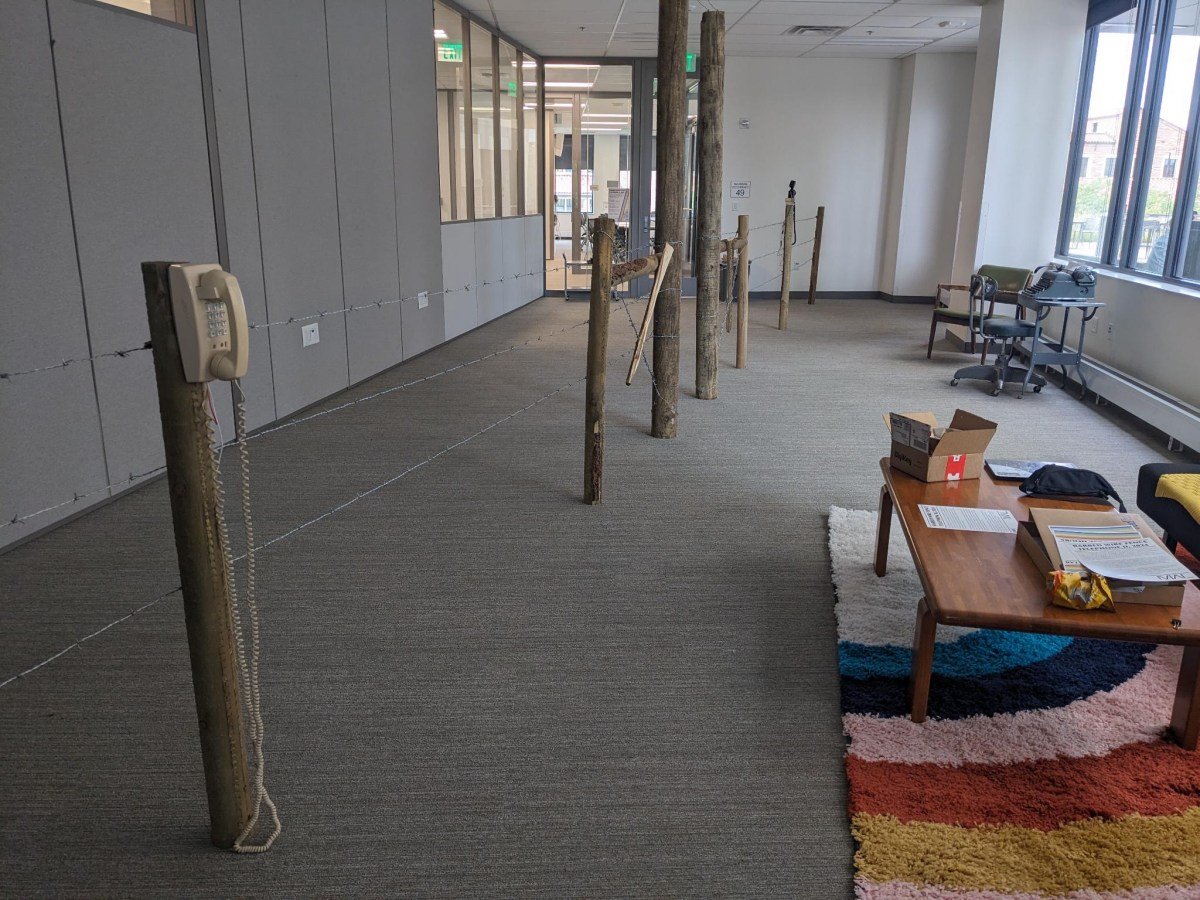
When I was researching barbed wire fence phones and wondering if any artists were bold enough to experiment with this other network, I came across Phil Peters and David Rueter’s work “Barbed Wire Fence Telephone”, which they installed in a Chicago gallery in 2015. Libby Striegel (managing director of the Media Archeology Lab through which we run many of our other network projects) and I decided we should see if we could get hold of Peters and Ruyter. Reinstall your barbed wire fence telephones on the CU Boulder campus…To our joy and surprise, they said yes. But even more delightful and surprising was the fact that the college where I now reside, the College of Media, Communication and Information (CMCI), enthusiastically supported our request to install this fence phone network in the university classroom! In fact, CMCI was not only supportive in principle, they helped fund the project and staff members also helped us drill holes, put up fence posts and put up barbed wire. Phil and Libby (with minor assistance from me) completed the installation of “Barbed Wire Fence Telephone II” on Thursday August 29th and on Friday August 30th Phil gave a practical demo of this ad-hoc network to a group of about 20 people.
Since very little documentation exists online about the history of this important communications network, below I am including the entry on barbed wire phones as well as the introduction I wrote for the section on barbed wire. I admit that I hope someone will add this information to Wikipedia and cite this post The Other Network: A Radical Technology Sourcebook (Forthcoming in 2025 by Anthology Editions).
***
barbed wire network
Barbed wire was originally proposed as an inexpensive and potentially traumatic material that could be used to create a fence and thus act as a deterrent to keep livestock within a confined area and/or keep out intruders. Alan Creel has documented several designs for wire that featured barbs in the 19th century, including a “wire-work grating for fencing and other purposes” proposed by the French inventor Lyons Eugene Grassin-Baledans in 1860. The first patent for barbed wire fencing in the US was granted to Lucien B. Smith of Kent, Ohio (US) in 1867. Illinois farmer Joseph Glidden submitted a patent in 1874 for an improved version of barbed wire that has since become the dominant design. As Reviel Netz states, after this point the physical control of wide open spaces was largely complete. Many farmers objected to the cruelty built into the barbed wire, the way the fencing meant it was no longer possible to move cattle, and the way it seemingly symbolized the end of free and open public lands; In particular they formed anti-barbed wire associations and urged legislators and government officials to enact laws to limit or regulate the use of wire. However, as the price of wire fell from twenty cents per pound in 1874 to two cents per pound by 1893, few ranchers could afford another type of fencing material. By the 1890s, the barbed wire industry had become so prosperous and powerful that they effectively suppressed all opposition to the wire. In the late 19th century, especially throughout the western US, the availability of cheap barbed wire made it possible to keep large herds of livestock on a scale that had not been possible until that time. It also played an important role in “settling” the American West by violently claiming individual ownership over land already occupied by Native Americans.
Aptly nicknamed ‘devil’s rope’, barbed wire is made of steel (with the addition of zinc, zinc-aluminum alloy, or a type of polymer coating such as polyvinyl chloride) and has single or double barbs spaced approximately four to six inches apart. To erect fencing, one only needs barbed wire, poles and materials to attach the wire to the posts. Finally, although this section focuses on its use as a cooperative, non-commercial form of telecommunications network, it is also worth noting the frequent use of barbed wire for trench warfare or as a security measure atop walls or buildings.
Source: Alan Creel, The Devil’s Rope: A Cultural History of Barbed Wire (Reaction Books, 2002); Lyons Eugene Grassin-Baledans, “Wire-work grating for fencing and other purposes,” France Patent 45827; Lucien B. Smith, “Wire Fence,” US Patent 66182A (25 June 1867); Joseph Glidden, “Improvements in wire fencing,” US Patent 157124A (27 October 1873); Reveal Netz, Barbed Wire: An Ecology of Modernity (Wesleyan University Press, 2009)
53. Fence Phone
Country of Origin: USA
Manufacturer(s): Unknown
Earliest known use: circa 1893
Basic materials: copper wire, barbed wire, posts, fasteners (such as nails or staples), insulators (such as ceramic knobs, glass bottles, leather, corn cobs, cow horns), battery-powered telephone handsets
Description: A fence phone, also known as barbed wire fence phone or squirrel lines, is the use of “smooth” (possibly copper) wire running from a house to a nearby barbed wire fence to create an informal, ad-hoc, cooperative, non-commercial, local telephone network. It was adopted primarily by farmers, ranchers, and people living in rural or isolated areas, particularly in the US and Canada, due to two major developments in the 1890s: the widespread availability and cheapness of barbed wire in the 1890s; and the erosion of Alexander Graham Bell’s patent monopoly in 1893 and 1894, which, according to Robert McDougall, led to a sudden explosion of 80 to 90 independent telephone companies making telephone sets that could be used outside the Bell telephone system. According to Ronald Cline, the sudden explosion of independent telephone companies gave impetus to the independent telephone movement. Not only had Bell largely neglected providing telephone service to rural areas in favor of focusing on urban areas, but early Bell Telephone owners were also intent on controlling telephone use. McDougall writes, “Bell’s early managers sought to limit wasteful telephoning, especially indecent activities such as courtship or gossip over the telephone, and to control certain groups of users, such as women, children, and servants, who were considered special offenders.” In contrast, according to Cline, independent telephone companies recognized that building lines in rural areas would be too expensive and instead openly advised “people in the agricultural sector to purchase their own telephone equipment, build their own lines, and form cooperatives to bring phones to rural areas.”
A practical way to overcome social isolation is needed; inform about emergencies, weather and crop prices; And fed up with efforts to curb free speech, cattlemen and farmers began to take advantage of the increasing ubiquity of both telephone sets and barbed wire fences. They would connect the telephones to their homes through a wire fixed to a nearby fence; At the time, telephones had their own batteries that generated DC current that could carry sound signals; Turning the crank on the phone will generate an AC current to produce a ring at the end of the line. Bob Holmes explains this process in detail: “The barbed wire network had no central exchange, no operator – and no monthly bill. Instead of a single address ringing through an exchange, every phone on the system rang for each call. Soon each house had its own personal ringtone…but anyone could pick up…conversations were free, and so people soon began ‘hanging out’ on the phone.” Fence phone lines can also be used to broadcast urgent information to everyone on the line. Reportedly, the quality of the signal traveling over the heavy wire was excellent, but the weather often caused short circuits that locals attempted to repair with anything that could serve as an insulator (such as leather straps, corn cobs, cow horns, or glass bottles).
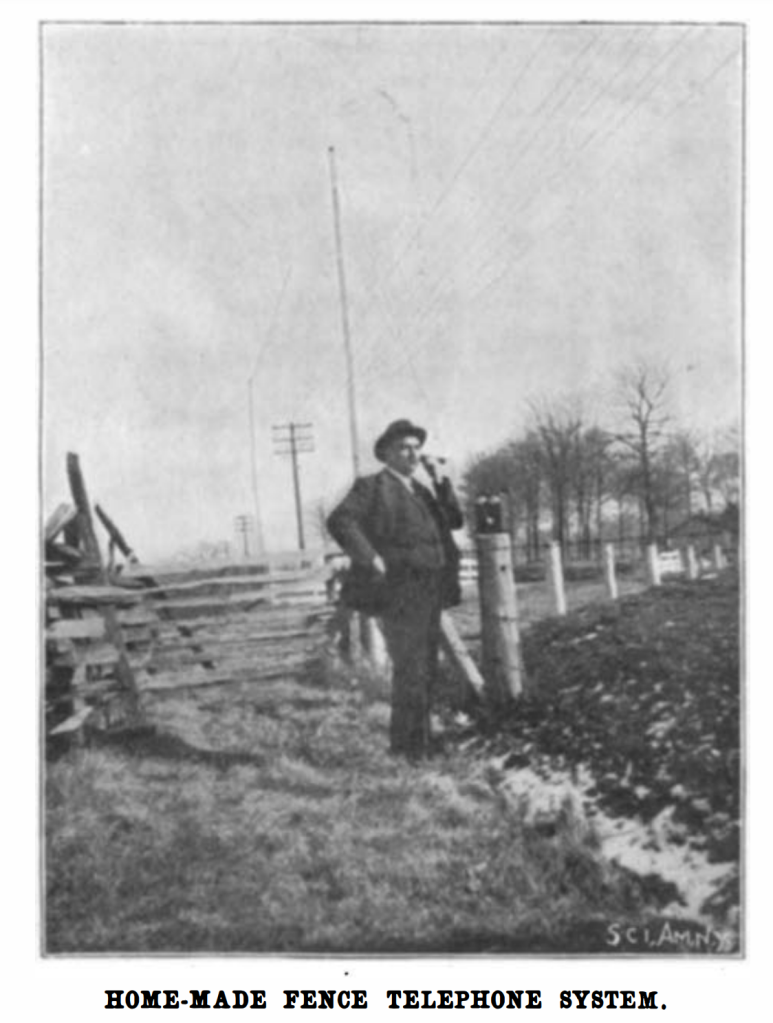
There are newspaper reports of fence phones being used by ranchers and farmers in US states such as California, Texas, New Mexico, Colorado, Kansas, Iowa, Nebraska, Indiana, Minnesota, Ohio, Pennsylvania, New York, Montana, South Dakota, and parts of Canada. For example, a 1902 issue of the Chicago-based magazine Telephony reported on a barbed wire fence telephone network that operated over a distance of 25 miles between Broomfield and Golden, Colorado (USA) and cost about $10 to build. The line was used for a “lady operator” to inform a worker at the end of the line “when to send water and how much.” The author says, “A unique feature of this system is that only the operator can initiate the talk. When the decision to send water is made the operator calls the person at the headgate and gives him specific instructions which he must follow. If he has anything to say he must say it immediately or must remain silent until called again, as this is not a circuit system and only the Broomfield office can make the call. This enables the woman to silence the other partner as per her wish and be able to have the last word.” Get benefits.” Fence phone systems also appeared to flourish in areas known for cooperatives, especially those related to agriculture. The cooperative network model particularly flourished in the 1920s as farmers experienced an economic downturn a few years before the Great Depression. For example, according to David Sicilia, farmers in Montana created the Montana East Line Telephone Association, each contributing $25 per year for telephone sets, batteries, wire, and insulators, as well as several dollars for maintenance.
Realistically, fence phones were still in use into the 1970s and perhaps even later. CF Eckhart describes calling his parents who lived in rural Texas and still used fence phones; They numbered just 37, specified by three long rings and one short ring on the smaller local network.
Source: Alan Creel, The Devil’s Rope: A Cultural History of Barbed Wire (Reaction Books, 2002); David B. Sicilia, “How the West Was Wired,” Inc.com (15 June 1997); Early W hiter, free range and fencingVol. 3 (Kansas State Teachers College of Emporia English Department, 1960); Robert McDougall, The People’s Network: The Political Economy of the Telephone in the Gilded Age (University of Pennsylvania Press, 2014); Ronald Cline, Consumers in the Country: Technology and Social Change in Rural America (Johns Hopkins University Press, 2002); “An Affordable Telephone System for Farmers,” scientific American82:13 (31 March 1900); “Bloomfield’s barbed wire system,” Telephony: An Illustrated Monthly Telephone Journal 4:6 (December 1902); Bob Holmes, “Wired Wild West: Cowpokes converse over fence-wire phones,” new scientists (17 December 2013); cf Eckhardt, “Before Mow Bell: Rural Telephone Systems in the West,” Texasescapes.com (2008); Phil Peters, “Barbed Wire Fence Telephone,” https://philipbpeters.com/ (2014)
<a href