-

matt walsh
Melbourne, Australia – There are still a few days left until the first round and the draw has just been released, but the Australian Open is already in full swing and more than 100,000 fans have already flocked to the gates.
Grand Slams have traditionally been ‘two-week events’ that, for most of the public, begin with first-round action on a Sunday or Monday, and end with the women’s and men’s finals played in front of packed stadiums two weeks later.
But a quiet revolution has swept through a Melbourne park. Tournament director Craig Tilley has made no secret of his drive to ensure the Australian Open – known as the Happy Slam – is a favorite among players and fans.
And with the week typically reserved for qualifiers and off-Broadway, making media-only events like seeding and draws part of an extended ‘Opening Week’ is a masterstroke that has already paid off.
For three days, from Monday to Wednesday of the opening week, 100,443 fans came to the gates of Melbourne Park. It’s been busy. There are lines of food vendors and the trams are packed. Over the course of three days last year, the Australian Open had the highest attendance ever? 47,095 punters participated – less than half.
But this is not luck on the part of Tilley and company, but a deliberate effort to bring more people to the tournament and ensure the Australian Open remains the people’s Slam.
All advertisements for the tournament showed the start date as January 12. Opening Week, though its meaning was possibly vague (is it Round 1, or is it qualifying?), was plastered all over the place. And there has been a big push to bring big names – whether tennis players, music artists, or food and drink vendors – to Melbourne parks early to improve the product and atmosphere.
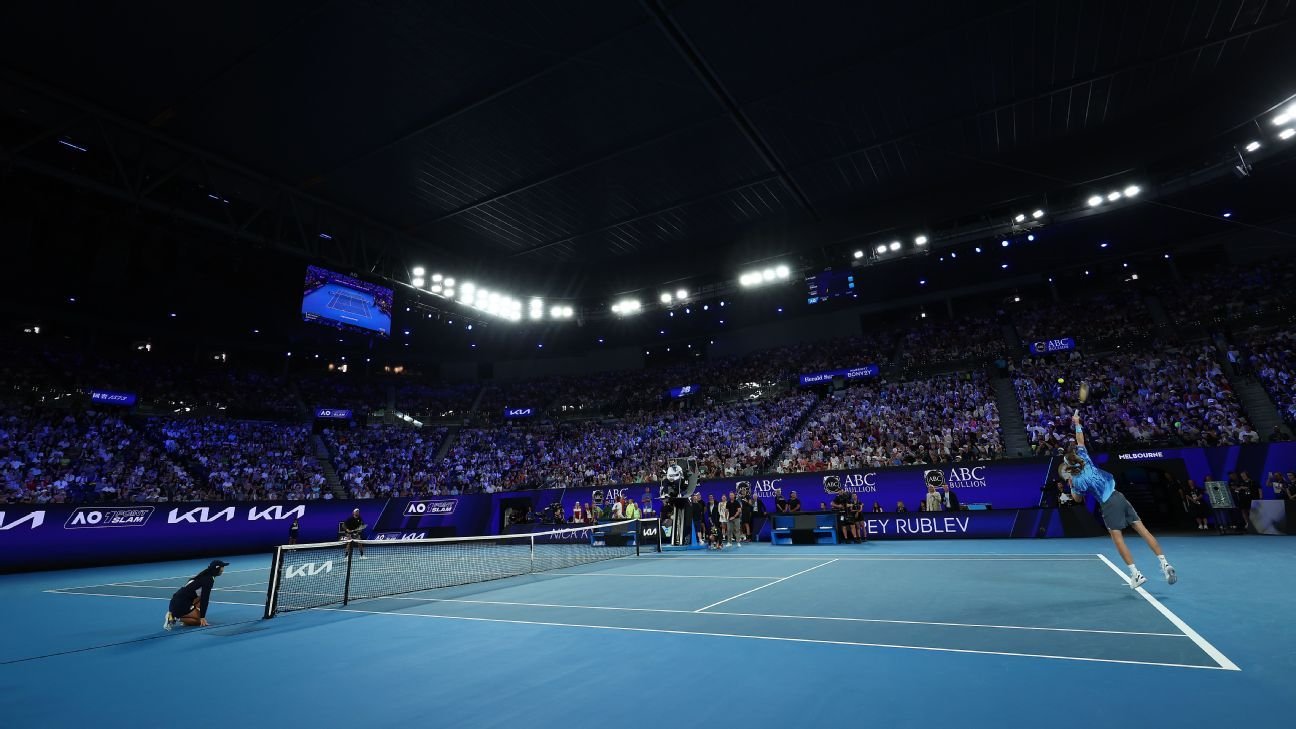
Take Wednesday night’s ‘1 Point Slam’. A simple base; A field of professionals such as Coco Gauff, Carlos Alcaraz and Jannik Sinner are pitted against local celebrities and amateur Australians, all competing for a A$1 million (US$668k) cash prize. Win a point and move on. No second chance. High drama, quality entertainment.
Last year, it was a one-day event on the much smaller courts of the Kia Arena (which can hold 5,000 spectators), and was not televised worldwide. This year, Tilley played it in prime time in front of 14,000 people at Rod Laver Arena and ensured that it was broadcast worldwide.
And everyone made purchases. Nerves were high among the qualifiers and professionals, who were not given access to a second serve. If they made a mistake, they were out. This softened the ‘second serve’ action, bringing amateurs into the competition. Who served and received was determined by the age-old classic: rock, paper, scissors.
The idea was so intriguing that social media was flooded with tennis fans wanting more. Next year in Melbourne, at other Slams. Even top ranked professionals had levels of FOMO.
Now that I’m actually watching it on TV, minus the one point slam on my part, it looks like a lot of fun 🙂
– Taylor Fritz (@Taylor_Fritz97) 14 January 2026
And what’s even more satisfying for everyone involved is that it was an amateur, Jordan Smith of New South Wales, who won the event and the million by defeating two-time defending Australian Open winner Jannik Sinner (who was eliminated by mistake), and top 10-ranked woman Amanda Anisimova defeated world number one to reach the final. 117 in the final (and 1 point slam qualifier) Joanna Garland.
The program was entertaining, if a little dragging, with a few commercial breaks (but hey, they pay the bills), but the idea has legs and will only grow in the future.
There’s more to come. Roger Federer will once again grace the Rod Laver Arena in what has been dubbed the inaugural ‘Opening Ceremony’ on Saturday night, a night before the main draw begins. He will appear in the ‘Battle of World No. 1’ alongside former rival Andre Agassi and Australian greats Patrick Rafter and Lleyton Hewitt.
Elsewhere throughout the week, Tilley also invested heavily in tennis-adjacent entertainment. World-class music acts have been booked to perform at reasonable prices at the complex during the usually quiet qualies. UK pop group Hot Chip, DJ Elderbrook, and renowned Australian electronic act The presets are among those performing to bring fans through the gates.
The grounds of Melbourne Park have also been improved again. More green spaces, more shade, more bars, more food shops, so much more to do and see. You can spend a day walking around and not see a ball get hit – and be satisfied.
Influencers and content creators are hard at work showcasing their Open-sponsored credentials, along with dozens of unique and exotic food and beverage vendors scattered around the grounds – the biggest attraction being American burger giant Shake Shack, which is making its debut as a pop up for the year’s first Slam. Social media is alive with content, and the main draw ball hasn’t even been hit.
But while it’s all positive for Tennis Australia and Tilley, there is also room for a healthy dose of skepticism. The coining of the qualifier week as ‘Opening Week’ has caused some outrage among fans, some of whom feel that the week was misrepresented.
One fan on TikTok described the practice as “super confusing.” Another said there was “no indication” that opening week referred to qualifying, and a third said “they really should have made it clear” that it was not main draw action.
But that may just be a small sample size, and you can’t argue with the numbers. 100,443 of them.
More than doubling the number of fans attending the first three days of Opening Week compared to 2025 is undoubtedly a huge success for Tennis Australia, and shows what can be achieved with innovation, quality entertainment, investment in infrastructure and hospitality, and perhaps a little ambiguity in marketing.
The Australian Open is truly a juggernaut. A world class event. A living, breathing monster that keeps ticking the right boxes.
<a href=