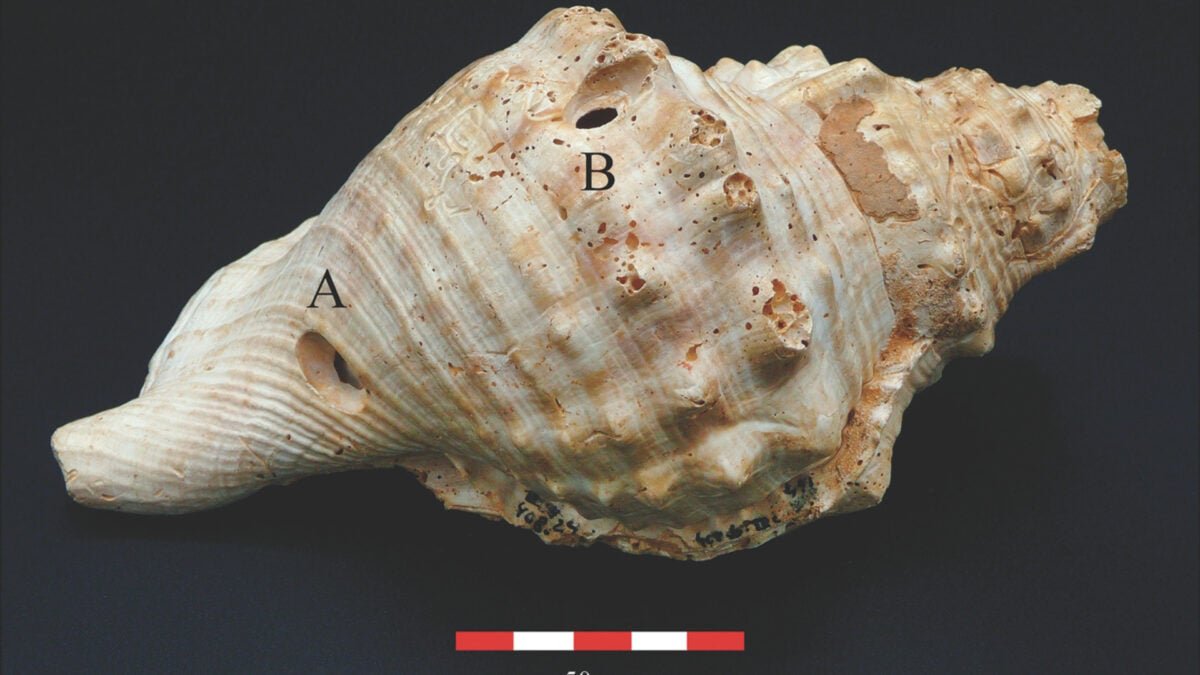
In a study published today in the journal Antiquity, researchers experimented with archaeological artifacts in a special way – by using them directly. He studied and examined conch trumpets from Neolithic (about 7000 to 1700 BC) sites in Catalonia, Spain. Their direct approach revealed that prehistoric trumpets may have been great for long-distance communication and may even have been musical instruments.
Catalonia is one of many places around the world where humans used shells to make noise. But according to a statement from Antiquity, the conch trumpet found there has been largely ignored in academia.
prehistoric sound-maker
“It was known that many Charonia Lampas “The shells were found in a relatively small area of Catalonia – specifically in the lower reaches of the Llobregat River and in the pre-coastal depression of the Penedès region, east of the city of Barcelona. Their tops had been removed, leading some researchers to suggest that they could have served as musical instruments,” said study co-author Margarita Diaz-Andreu, an archaeologist at the University of Barcelona. The top of a shell is the tip of the spiral.
Furthermore, evidence suggests that humans probably collected the shells when the mollusks inside had died – apparently not to eat, but to use them as instruments to produce sound. To further test this theory, Díaz-Andreu and his colleague Miquel López-García, also a co-author and archaeologist at the University of Barcelona, studied shell trumpets and played them to understand their acoustic characteristics. The shells used in the study are between 5,000 and 7,000 years old. Who knows how long it’s been since these instruments made sounds?

Luckily, López-Garcia is also a professional trumpet player, so in addition to seeing if they could be used in long-distance communications, he could also assess their potential as a musical instrument. López-Garcia reported that the two eventually discovered that “shell trumpets are capable of producing high-intensity sounds and must have been highly effective for long-distance communication.” “However, they are also capable of producing melodies through pitch modulation, so the possibility cannot be ruled out that these shells were also used as musical instruments with expressive intent.”
important equipment
The Catalonian region in question was densely populated, and conch trumpets have come to light in wide areas of settlements, indicating that they may have supported communication both within and between groups. They were probably involved in the agricultural and mining activities of the area. Thus, the study shows that shell trumpets influenced the spatial, economic, and social dynamics of Neolithic communities, bridging the gap with sound-based communication as well as possibly music.
“Our study shows that Neolithic people used shells not only as musical instruments, but also as powerful tools for communication,” Professor Diaz-Andreu said.
<a href