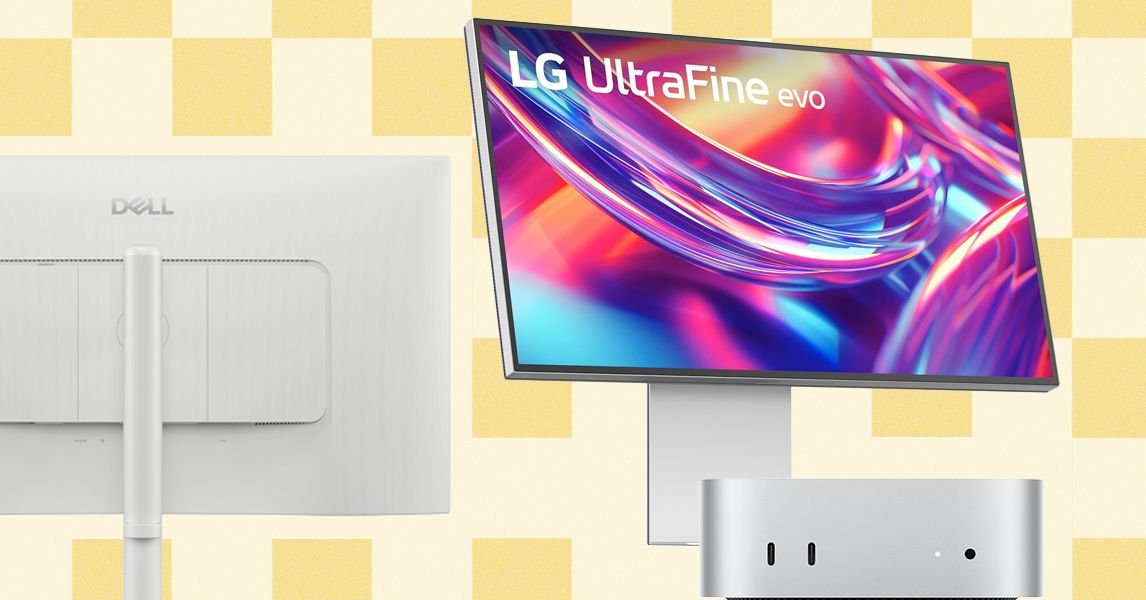
Size and resolution: 27-inch and 32-inch monitors are the most common sizes these days, and larger options exist as well. I’d also consider a 34-inch ultrawide monitor if you like a wider, 21:9 aspect ratio with a curved shape. With Apple, resolution is king. That’s why it invests so much in higher pixel density for every screen it sells, even entry-level options like the MacBook Air. Pixel density is what gives a screen its sharpness, and you need a lot of pixels when they’re spread out on a large, external monitor. If you want to maintain fidelity, I wouldn’t buy anything under 4K, and moving up to 5K or 6K on a 32-inch monitor might be helpful. You also want to consider the refresh rate here. The MacBook Pro has a 120-Hz refresh rate, which provides smoother animations, especially in games.
Adjustment Capacity: Apple monitors and iMacs aren’t really known for adjustability. Often they don’t have anything, and when they do they cost more. This is not the best for your posture and ergonomics. Famously, Pro Display XDR charges an additional $1,000 to add a Pro Stand with proper adjustability. For ergonomic purposes, the top of the screen you’re working on should be as close to eye level as possible, and this depends on one’s height. If the monitor doesn’t have height adjustment capabilities, you’ll have to rely on a separate monitor stand or arm. In addition to height adjustment, many monitors also have a stand that can swivel, tilt, and rotate, which are important when using multiple monitors simultaneously. This is also needed if you want to use a second monitor vertically, which has become increasingly popular.
Port: Even the cheapest monitors will always have HDMI as a connection, which you need to connect directly to the back of the Mac Mini. Some monitors have USB-C supporting displays, which will let you connect to one of the Mac Mini’s Thunderbolt ports. The M4 Mac mini comes with three Thunderbolt 4 ports, HDMI, and an Ethernet jack. The M4 Pro models have the same ports, except the ports are Thunderbolt 5 instead of 4. If you want to connect more than one external monitor you’ll need to use at least one of these Thunderbolt ports. These monitors also have other ports, such as USB-A. These can be useful, as the Mac Mini itself doesn’t have anything.
image quality: Apple prides itself on the image quality of its Macs, so in the case of a Mac Mini, you’ll probably want to get something your Mac is worth. This is especially important for content creators, photographers, and designers. So, you’ll want to consider the monitor’s brightness, color accuracy, color coverage, and contrast. While some IPS displays provide good colors and contrast, Mini-LED or OLED displays will guarantee better image quality. They also have high peak brightness for HDR content, which really brings games and movies to life.
<a href