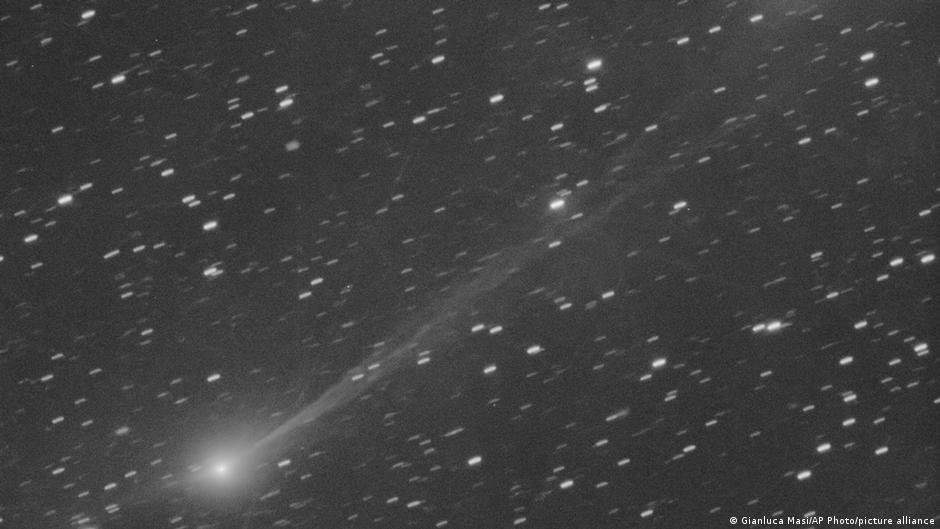
NASA “very much wants to find signs of life in the universe,” said Associate Administrator Amit Kshatriya, but the interstellar object, called 3I/ATLAS, was not that.
The US space agency on Wednesday released fresh photos of the object that passed near Mars last month.
“I think it’s important that we talk about it. This object is a comet,” Kshatriya said. “It looks and behaves like a comet. And all the evidence points to it being a comet.”
US government shutdown fuels foreign speculation
Speculation that it was not a comet came during the US government shutdown, which prevented NASA from responding at the time.
Despite the blurry images, the agency says it has studied 3I/ATLAS using more than a dozen scientific platforms, including the Hubble and James Webb space telescopes and Mars-orbiting satellites. Two European Space Agency satellites around Mars also made observations.
“We were immediately able to say, ‘Yes, it definitely behaves like a comet.’ “We certainly haven’t seen any technical signatures or anything that would lead us to believe it’s anything other than a comet,” said Nicola Fox, associate administrator for NASA’s Science Mission Directorate.
“It was great that the world was surprised along with us,” he said.
3i/atlas is leaving the solar system
Named after the telescope in Chile that first observed it in July, this comet is believed to be older than our solar system.
NASA scientist Tom Statler called 3I/ATLAS “a window into the deep past, and into a past so deep that it predates the formation of our Earth and our Sun,” saying, “It gives me goosebumps just thinking about it.”
Its origin remains unclear, but it is on its way out of the Solar System. The comet’s closest approach to Earth will be 167 million miles (269 million kilometers) in mid-December.
NASA says the comet is visible from Earth before dawn using binoculars or a telescope.
Edited by: Shawn Sinico