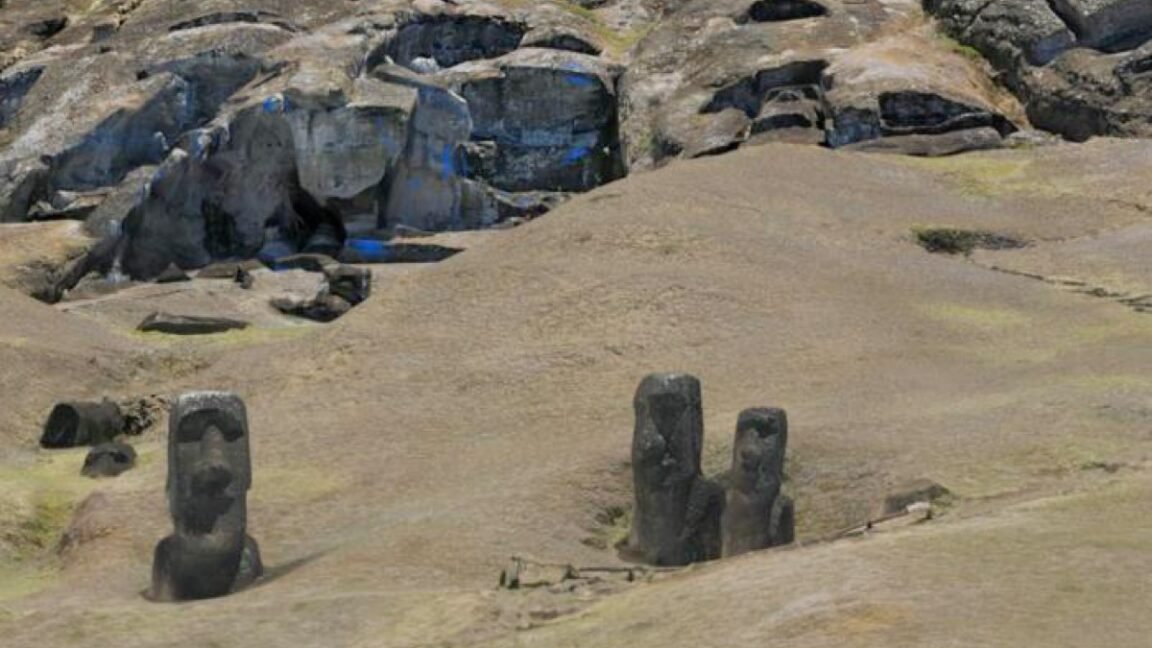
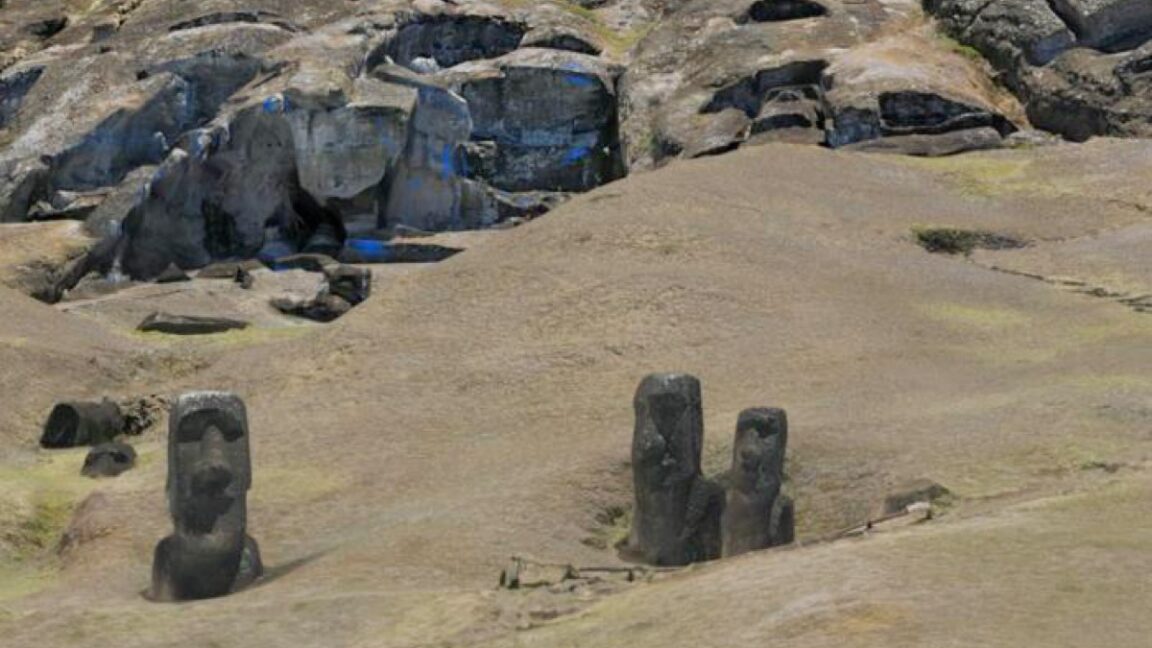
Easter Island is famous for its giant monumental statues, called moai, which were built about 800 years ago. The volcanic rock used for the moai came from a mine site called Rano Raraku. Archaeologists have created a high-resolution interactive 3D model of the mine site to learn more about the processes used to create the moai. (You can explore the full interactive model here.) According to a paper published in the journal PLoS ONE, the model suggests that there were multiple independent groups, perhaps family clans, that built the moai, rather than a centralized management system.
“You can see things that you can’t really see on the ground. You can see tops and edges and all kinds of areas that could never be reached on foot,” said co-author Carl Lipo of Binghamton University. “We can say, ‘Here, look at this.’ If you want to see different types of carvings, fly around and look at the stuff there. We’re documenting something that really needs to be documented, but in a way that’s really comprehensive and shareable.
Lipo is one of the leading experts on the Easter Island moai. In October, we reported on Lipo’s experimental confirmation – based on 3D modeling of the physics and new field tests to recreate that motion – that the people of Easter Island transported the statues into the vertical position, with workers using ropes to essentially “walk” the moai on their platforms. To explain the presence of so many moai, the assumption has been made that the island was once home to thousands of people.,
Lipo’s latest field tests have shown that the “walking” method can be accomplished with far fewer workers: 18 people, four on each side rope and 10 on the rear rope, to achieve side-by-side walking motion. They were quite efficient in coordinating their efforts to move the statue 100 meters in just 40 minutes. This is because this method works on basic pendulum dynamics, which reduces friction between the fulcrum and the ground. It is also a technique that takes advantage of the gradual build-up of amplitude, which suggests a sophisticated understanding of resonance principles.
<a href