Following in Amazon’s footsteps, two student projects independently use ‘collaborative filtering’ to bring recommendations and social networking to online music; Soon he will join the army.

What we now know as the “Social Web” – or Web 2.0 – did not arrive until around 2004. But its first signs had emerged only a few years ago. As always, music was the precursor.
Last.fm was founded in 2002 by a group of four Austrian and German students at Ravensbourne College of Design and Communication, London. It was designed as an Internet radio station that allowed users to create a listening profile and share it with others. The year of its launch, Last.fm won a Young Talent Award at the Europrix, a multimedia awards show based in Vienna. In a showcase video (embedded below) before the awards ceremony the product was described as follows:
“After repeated use, the system builds a listening profile that increasingly reflects the user’s preferences. The sum of all profiles is seen in the ‘Map of Music,’ a presentation of musical connections and genres determined only by the collaborative effort of Last.fm users.”
When the students went to receive their awards, one of them, Thomas Willomitzer, noted the importance of “collaborative filtering” in the Last.fm system. The idea was that the Last.fm algorithm would recommend music you might like based on your listening history and the listening history of other similar users. Willomitzer said this type of algorithm would be familiar to people who used Amazon.com.
Here’s a video of the Last.fm founders presenting at Europrix 2002, via Thomas Willomitzer:
Collaborative filtering was a common technique in recommended systems, and its history predates the Web – for example, it was the basis of a 1992 Xerox PARC email system called ‘Tapestry’. But collaborative filtering really came into its own during the web age, and was especially popularized by Amazon. By 2002, Amazon users were familiar with the following message: “Customers who purchased items in your shopping cart also purchased…” There was also a “Your Recommendations” list on the Amazon.com homepage. Both of these features were created using an algorithm that Amazon called “item-to-item collaborative filtering.” As explained in a research paper:
“Instead of matching the user with similar customers, item-to-item collaborative filtering matches each item purchased and rated by the user with similar items, then combines those similar items into a recommendation list.”

The key point here is that Amazon’s collaborative filtering was based on the items people purchased or rated, not the profiles of its users. This approach was also important for how new social web services like Last.fm would develop. The “map of music” that Last.fm created was about mapping which songs (or genres) were related – so a certain Bob Dylan song might have a strong connection to a certain Joni Mitchell song based on listener data, and thus the Mitchell song might come up as a recommendation to people who have heard the Dylan song (and vice versa).
audioscrobbler
Coincidentally, another student in the UK was also working on a recommendation system for music in 2002. AudioScrobbler was started as a computer science project by Richard Jones at the University of Southampton. Jones coined the term “audioscrobbling” (later shortened to “scrobbling”) to describe the process of tracking the songs you listen to to create a listening profile, which is then used for recommendations.

In an interview with his university paper in April 2003, twenty-year-old Jones explained how AudioScrobbler works:
“Users of the system are required to download software to their computers that keeps track of which artists they listen to. The data is then collected and a pattern emerges through a technique called ‘collaborative filtering.’ The results are then recorded against a username and can be compared with the listening tastes of other members.
Later, Jones teamed up with students at Ravensbourne College to transform his project into Last.fm, but even in 2002 – when they were independent products – it’s surprising how similar the two systems were. Both used collaborative filtering to create song recommendations, and both aimed to create a kind of social network based on what users listened to.

Avoiding broadcast model
The key to the emerging social web will be to discover new content and communities following other peopleFor music, the idea was to help you break away from the established broadcast model, At the EuroPrix event, Last,fm’s Martin Sticksell took out a 1980s-style transistor radio to illustrate the issue, If you want to listen to music on such a device, Sticksell explained, you have to tune to the frequency band to find your station, If you don’t like the music playing on that station, you tune the dial to another radio station and try your luck again,
“The inherent problem with broadcast media is that basically, at the end of the day, there’s always someone else selecting the music for you,” Sticksell said. “So there’s always a group of editors or programmers that choose the music and put them into a program for you.”

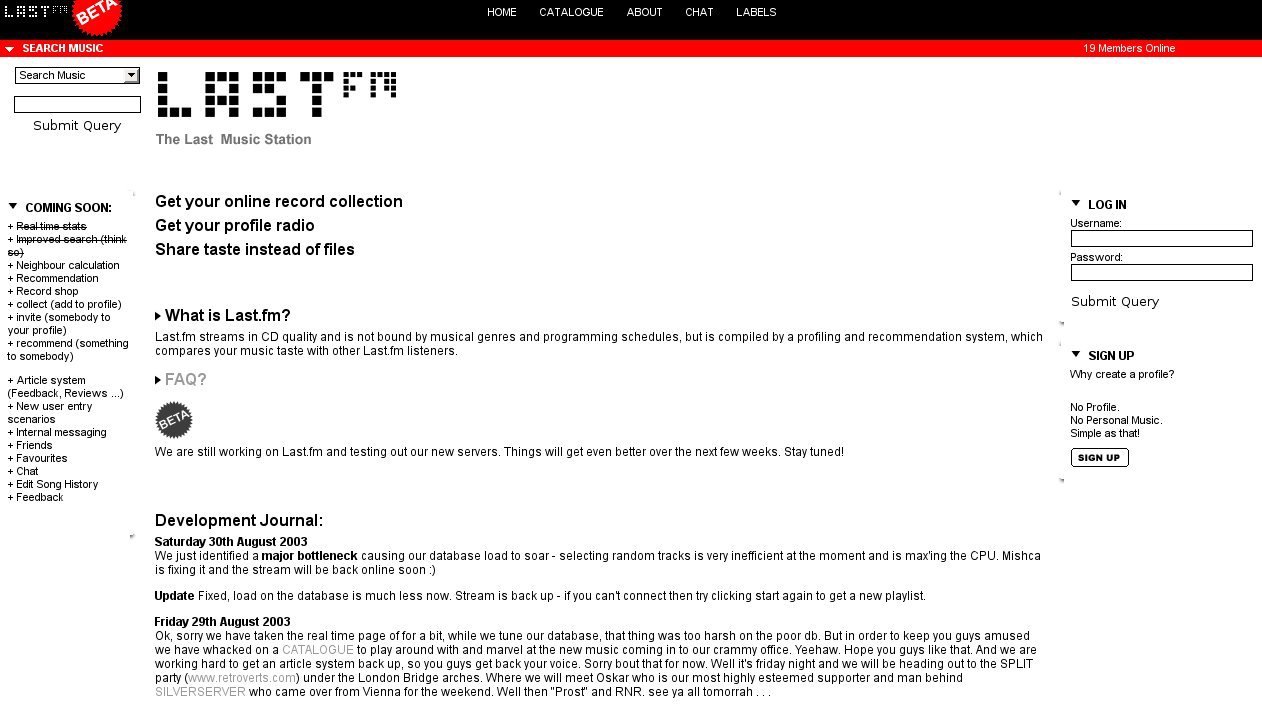
With Last.fm, the music you heard was a mix of manual selection and algorithmic selection. You can start with a song you already have in your online “record collection” (continued use of the term Stickcell), or start from another user’s profile. From then on, songs will be selected for you based on collaborative filtering. If you’ve played a song, the Last.fm software automatically adds it to your collection. You can also press the “Love” button to add it. But if you don’t like a certain track, you can press the “Hate” button (so that it is not played again), or click the “Skip” button to skip to the next song. There was also a “change” button to go to a different user profile.
The initial Last.fm user interface was, actually, a little cluttered with all these different buttons and different search boxes – but over time it became more streamlined.

Sticksell explained that the idea for Last.fm came when students asked themselves, “How do you find something you don’t know?” So in terms of music, how to discover new music when you don’t know what type of music you’re looking for? The answer, he said, was the social component.
“Then we realized it’s the social aspect of music – the best music you always get is when you go over to your friend’s house and he plays the record for you. And we’re taking that concept here to an online environment.”
value of user data
In 2002 both Last.fm and Audioscrobbler stumbled upon the collective value of user data in the search for new content – something that Amazon was also taking advantage of at this time. However, the problem with music was that licensing from record companies was still highly restrictive. The founders of Last.fm highlighted this to some extent during their Europrix presentation, but they admitted that “due to legal issues, we are only allowed to play 30 second samples.” Unless you already had a piece of music, you only had 30 seconds.
However, by the following year, Last.fm had begun to transform itself into an “online radio” service by paying license fees to the UK collecting societies PRS (Performing Rights Society) and MCPS (Mechanical-Copyright Protection Society).
So pre-Web 2.0, the streaming revolution was just beginning. But with Last.fm and Audioscrobbler, we at least saw a glimpse of the future of the social web.

buy book
My Web 2.0 Memoir, Bubble Blog: From Outsider to Insider in Silicon Valley’s Web 2.0 RevolutionNow available to buy:
Or search for “Bubble Blog McManus” at your local online bookstore.
<a href