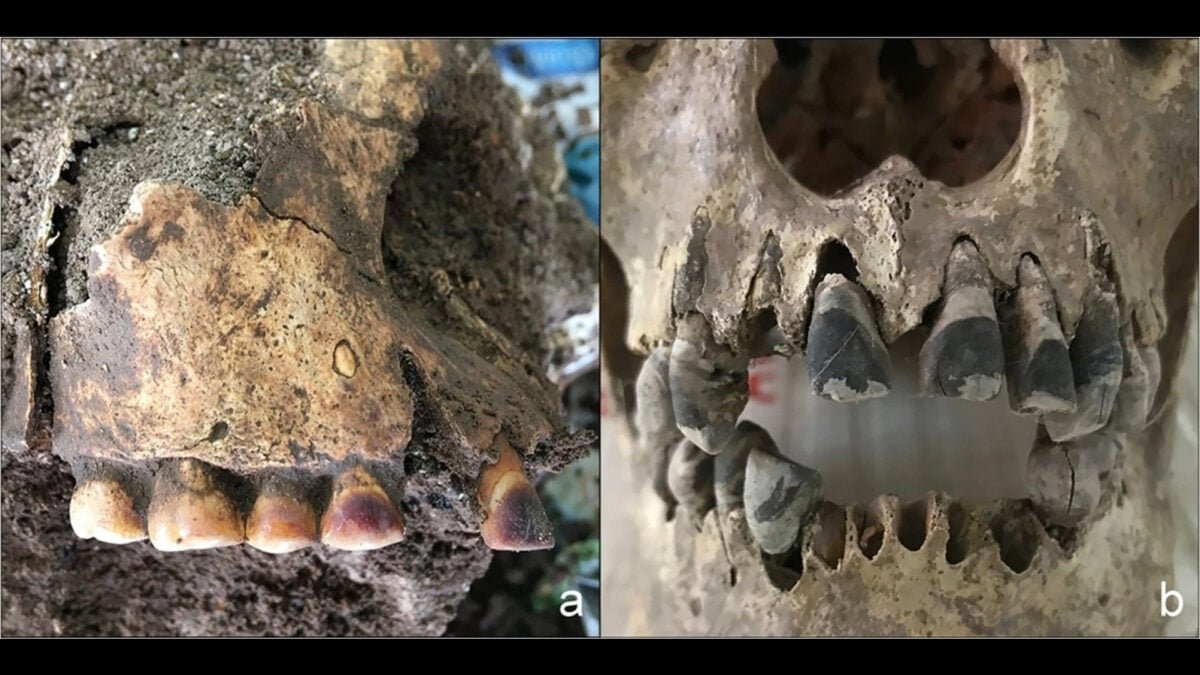
According to historical records, polished black teeth were considered a high standard of beauty in parts of Vietnam as far back as 400 BC. Archaeologists have now uncovered physical evidence that this was the case at least 2,000 years ago, their findings are reported in a recent paper published in Archaeological & Anthropological Sciences. For the study, researchers used non-invasive methods to examine skeletons found in Dong Xa, a region in northern Vietnam.
“This research clarifies both the antiquity and specific techniques of tooth blackening in Vietnam,” the team explains in their paper, adding that the practice “underscores a culturally embedded expression of identity within broader networks of interregional interaction and exchange.”
history of black teeth
Given the modern preference for bright white teeth, dark black teeth may seem odd. In fact, Western influences in Asia have eliminated this tradition for younger generations, but according to the newspaper, teeth blackening has a rich history of cultural significance in South Asia, Oceania and parts of Africa and the Americas.
“This practice is still seen today, not only in Vietnam, but also widely in parts of Southeast Asia,” Yu Zhang, lead author of the study and archaeologist at the Australian National University, told Live Science.

The Vietnamese in particular were known for their complex method of blackening teeth, a multi-step process that included “cleaning, red staining, black staining, and polishing,” the paper noted. However, archaeologists studying skeletons from the region were not unanimous on what caused the blackening of teeth.
For example, some skulls had reddish-brown teeth that may have been caused by natural staining from eating certain plants, not necessarily blackened teeth. Accordingly, researchers were divided on the exact procedures for blackening teeth in ancient Southeast Asian communities.
basic beauty standards
The new study tried to draw a clear distinction between intentional blackening and natural staining. The team selected skeletons from previous excavations at the Dong Xa site, located in an area of northern Vietnam known for hosting a rich archaeological record of Iron Age bronze artifacts.

The team used X-ray fluorescence to indirectly identify the chemical composition of the skeletons’ enamel. Based on that analysis, they looked at ethnographic evidence to explore possible connections between modern teeth blackening practices and ancient skeletons.
Perhaps not surprisingly, researchers found high levels of iron and sulfur in the ancient enamel samples. This points to the involvement of iron salts, Zhang told Live Science.
If true, this is consistent with the modern method of blackening teeth, a week-long process that uses a combination of iron salts and tannin-rich plants such as betel nut to darken teeth deeply. This would also mean that the process would leave people with blackened teeth for the rest of their lives.
something to chew
According to the paper, the implications of the new findings extend far beyond ancient beauty standards. Historical records note “significant technological and social changes during the Iron Age” in modern Vietnam. This led to the spread of iron use in this particular community, so it makes sense that prevalent beauty standards had something to do with iron use, the researchers explained.
On the other hand, biomolecular evidence of betel nut chewing – possibly a separate practice of blackening teeth – dates back to 2,000 BC and was observed beyond Vietnam. Therefore, the potential connection between the two could be another avenue of investigation, the researchers said.
But the findings highlight the longevity of teeth blackening in Vietnam, even as its impact has diminished in the region. It actually appears to be a fashion trend that lasted more than a few lifetimes — remarkably, as the new study shows, with some changes in methods.
<a href